

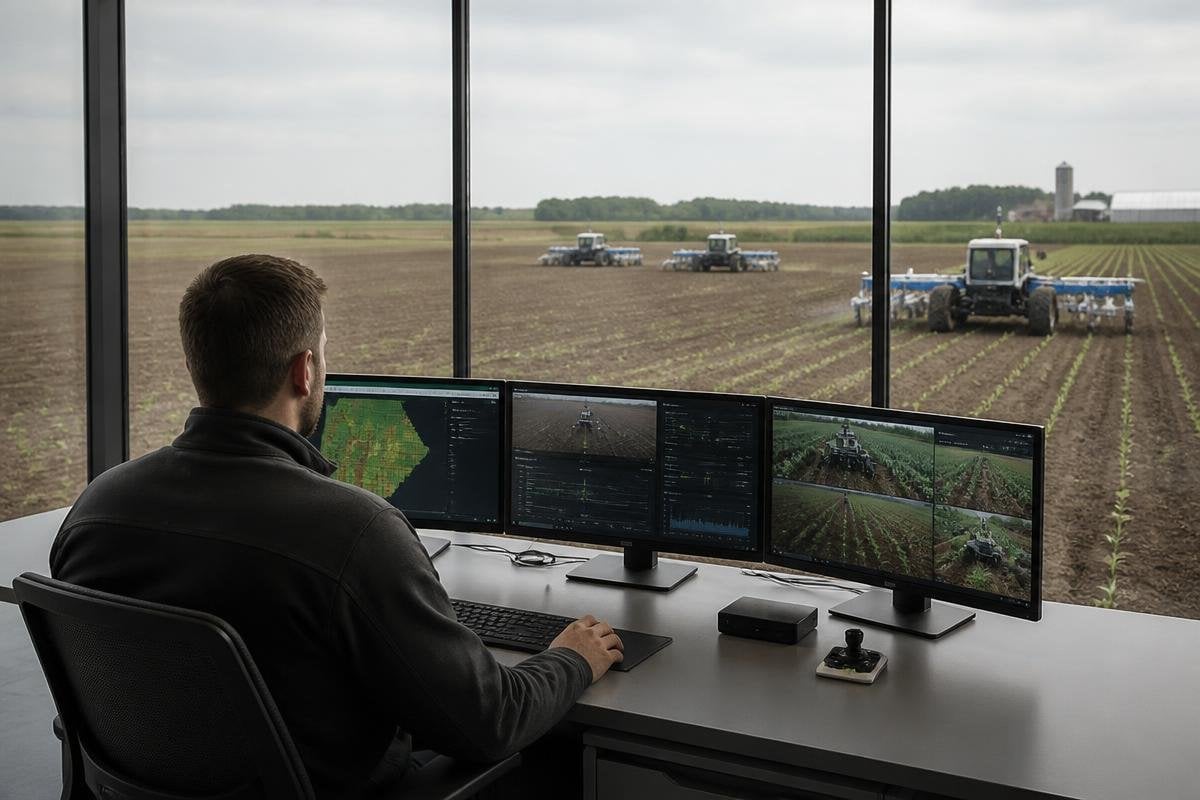
A fully automated farm would still have people working every day. Their work would shift from driving machines and checking rows by hand to setting tasks, watching systems, and handling problems that software cannot solve alone.
Quick read
- Field robots could repeat set routes for planting, spraying, weeding, or inspection.
- Farm software would connect machines with weather, soil, crop, and supply data.
- People would still make choices when crops, machines, or conditions fall outside the plan.
The work moves to software
Automation starts with a map of the farm and a list of tasks. Software can assign a route, send instructions to a machine, and record what happened during the run.
That record matters because farm work changes with weather, soil, crop growth, and equipment. A plan made in the morning may need a new route by afternoon. The system must accept new information and let a person change the task without stopping the whole operation.
The machines also need a way to locate themselves. Cameras, satellite signals, sensors, or LiDAR can help a robot find its position and detect objects in its path. The right mix depends on the crop, field shape, light, dust, and internet connection.
What machines can handle
A machine is a good fit when the task repeats, has clear limits, and can be checked with sensors. A field robot may follow rows, measure plant condition, remove weeds, or carry materials along a known route.
The value comes from repeatable work. It can run the same path at a planned speed and save a record for each pass. That gives a farm a clearer view of where work happened and where a task still needs attention.
Autonomous systems also change the layout of farm work. Charging points, service areas, access paths, spare parts, and network coverage become part of the operating plan.
A robot that cannot reach its charger or send its data has stopped being useful, even if its motors still work.
On a farm, that failure can stop a field task before anyone notices. Robot24 reports on farm robots and the companies building them, giving you named machines to compare before the next section looks at the work people still do.
Where people remain
Fully automated does not mean people disappear from the process. Someone still sets crop goals, checks machine health, approves changes, and decides what to do when a sensor gives a poor reading.
A system may spot a plant with an unusual shape. It may not know if the cause is disease, damage, poor soil, or a camera error. That decision needs field knowledge, and the person may need to inspect the plant before the software sends a new instruction.
Safety adds another limit. Farms contain people, animals, uneven ground, water, chemicals, loose material, and large moving equipment. A machine needs clear rules for stopping, waiting, and asking for help when its view is blocked.
The same applies to repairs. A farm with many autonomous machines needs people who can check sensors, replace parts, fix network faults, and restore a machine after a stop. Remote support can reduce travel, but it cannot remove the need for local skills.
The cost is more than the robot
The purchase price is only one part of the decision. A farm also needs power, storage, software, network access, training, service plans, spare parts, and time to change its work routines.
A cheaper machine may create more work if it needs frequent cleaning or sends poor data. A capable machine may still fail as a business purchase if it covers too little ground or needs a person beside it for every task.
I’d judge a farm automation plan by the work it removes from a person’s day, not by the number of robots in the field.
A practical test before full automation
Use these checks before moving a task from a person to an autonomous system:
- Name the task: Write down the exact job, route, start condition, and finish condition.
- Check the exceptions: List the cases that need a person, such as blocked rows, damaged plants, or lost signals.
- Measure the handoff: Set a clear method for the machine to stop and pass the problem to a worker.
- Price the support: Count charging, repairs, software, training, network service, and spare parts.
- Run a small area: Test the system where a person can inspect results and change the plan.
A farm reaches useful automation when the system can repeat its assigned work, report its limits, and leave people with decisions that need judgment. The control room may sit beside the fields or far away, but someone still needs to decide what the machines do next.
